
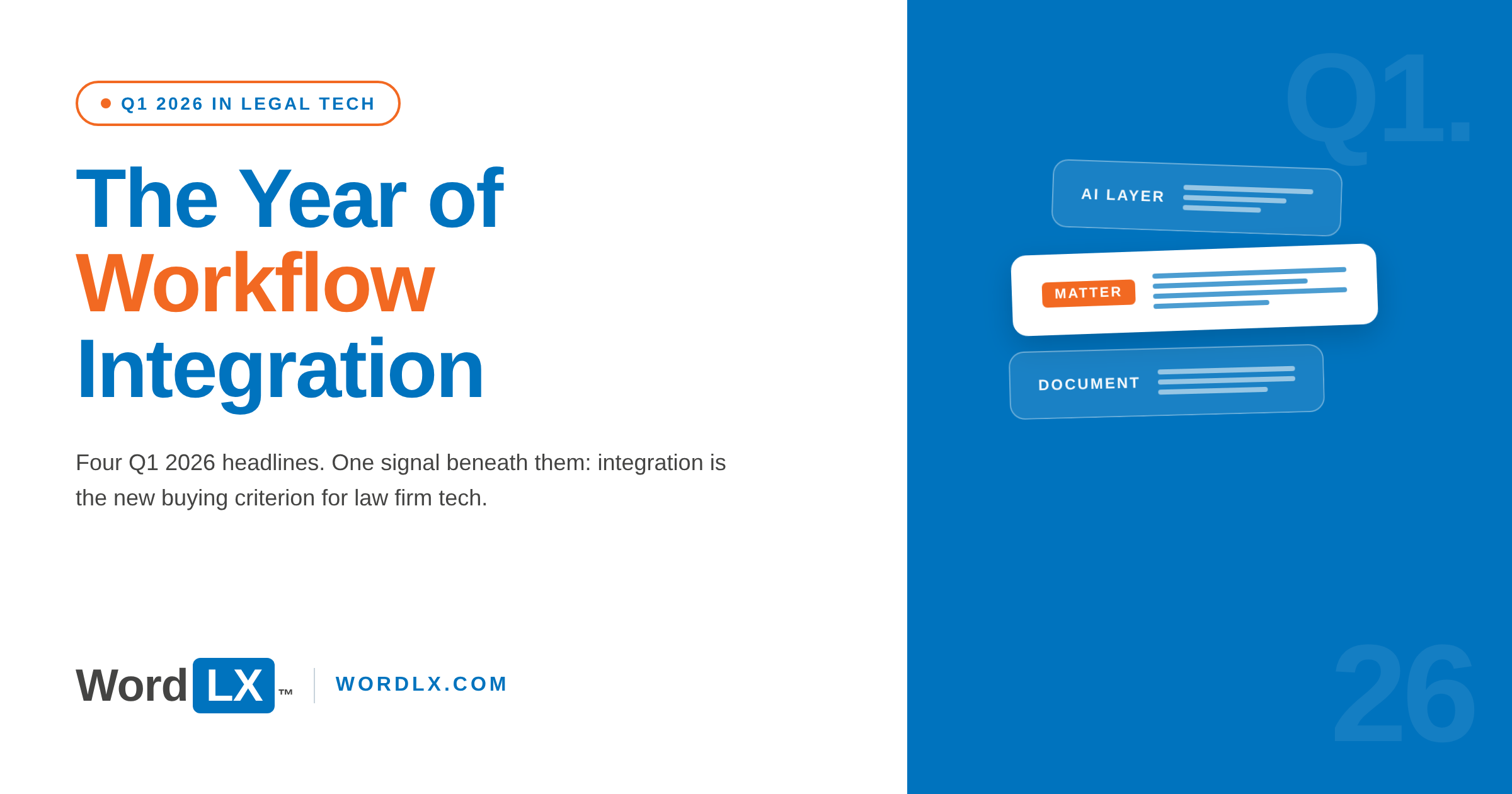
Four headlines defined Q1 2026 in legal tech. They look unrelated. Read them together and the pattern is hard to miss.
In February, Anthropic launched the Claude Cowork legal plugin, and the legal SaaS market shook hard enough that the press started calling it the “SaaSpocalypse.” Days later, a San Francisco law firm made the news for replacing a departing associate with AI and reporting a 27% cost reduction. In March, Harvey closed a $200M round at an $11B valuation. In April, Actionstep and iManage announced native integration between matter management and document management, ending years of stitched-together middleware.
Four announcements, one signal. Q1 2026 was the quarter the legal tech industry stopped buying isolated point solutions and started demanding integrated workflows. Firms now want the document layer, the matter layer, and the AI layer to move as one. Tools that sit between layers are getting repriced upward. Tools that cannot integrate are getting repriced downward.
This piece reads the four moments together and shows what they actually mean for your firm’s tech stack.

Table of Contents
- The Four Moments That Defined Q1 2026
- The Pattern Beneath the Headlines
- The Three Layers of a Modern Law Firm Tech Stack
- Why Microsoft Word Is the Operating System of Legal Work
- What Firm Leaders Should Do Next
- FAQ
The Four Moments That Defined Q1 2026

February. The Anthropic Cowork shock and the SaaSpocalypse.
Anthropic’s Cowork plugin was the first AI launch in legal tech that the public-market and venture-side analysts read as systemic rather than categorical. Inside a week, several mid-cap legal SaaS valuations corrected. Bloomberg Law and Reuters covered the reaction. The phrase “SaaSpocalypse” started showing up in legal-tech LinkedIn comment threads within 48 hours.
The market reaction reflected a new realization. The AI layer was about to compress the case for narrow, single-purpose legal point tools. When an AI assistant can sit on top of a matter and a document and produce useful work across both, the standalone tool that only handles one slice of the workflow loses its premium.
February. A San Francisco firm replaces a departing associate with AI.
Above the Law ran a piece on a San Francisco firm that left a departing associate’s seat empty and leaned on AI tools instead, reporting a 27% cost reduction for the relevant practice area. The headline did the rounds. The reframe matters more.
The substitution worked because the firm already had structured documents and clean templates for the model to operate against. Without that foundation, the AI would have produced inconsistent output, the partners would have caught it on review, and the cost story would have inverted. Read carefully, it is a foundation story dressed as an AI story.
March. Harvey raises $200M at an $11B valuation.
Harvey closed $200M in March at a reported $11B valuation, covered by Financial Times and Reuters. The funding number is the headline. The product direction is the signal worth watching.
Harvey is positioned increasingly as a matter-layer agent that lives across the firm’s full stack, talking to the DMS, the matter system, the document layer, and the email layer. The $11B valuation is the market’s bet that the agent that spans layers is worth more than the tool that owns one.
April. Actionstep and iManage announce native integration.
In late April, Actionstep (matter management) and iManage (document management) announced native integration. The trade publication Artificial Lawyer covered the announcement. For firms that have run both systems, the announcement closed a seam that everyone had quietly worked around for years.
Both vendors stopped trying to be each other, and stopped pretending the seam between them did not matter. Native integration is now table stakes for any firm-grade vendor that operates between layers.
The Pattern Beneath the Headlines
Read the four moments in sequence. They share one motion. Buyers are no longer asking “what does this tool do.” Buyers are asking “where does this tool sit in my stack, and what does it touch on either side.”
Three downstream effects are already visible in Q2:
- Tools that cannot integrate are getting repriced downward. The market read on standalone point tools is harsh, and the procurement conversations bear it out.
- Tools that sit between two layers (DMS plus matter, matter plus AI, document plus AI) are getting repriced upward. Harvey’s valuation is the cleanest example. The Actionstep plus iManage announcement is the operational example.
- The procurement conversation has shifted from feature checklists to workflow continuity. CIOs and Directors of Operations now open vendor calls with integration questions instead of feature questions.
The shift is being led by buyers, not by vendors catching up to a new narrative. Firms got burned in 2023 to 2025 buying narrow legal AI tools that produced impressive demos and broke on real workflows. Firms that bought five point solutions and then could not stitch them together are now asking integration questions first, capability questions second. Legaltechnology.com and other trade outlets have been tracking the shift in tone across vendor-RFP responses since late 2025.
This is also the moment where the compounding cost of an unstable foundation shows up at scale. We covered the dynamic in detail in Why “Fixing It Later” Costs Law Firms More Than They Think. Add an AI layer on top of an unstable document layer and the small problems get loud fast.
The Three Layers of a Modern Law Firm Tech Stack
The integrated stack has three layers. Top to bottom:
The AI layer. Drafting, research, summarization, agentic workflows. Harvey, Claude Cowork, Copilots inside Word and Outlook. The layer that gets the headlines.
The matter layer. Where the matter lives. Actionstep, Clio, NetDocuments, iManage. Billing, conflicts, communications, document orchestration. The layer that gets the operational attention.
The document layer. Microsoft Word, where 60% to 80% of repeatable firm output actually gets produced. The layer that gets taken for granted.
The headlines all year went to the AI layer and the matter layer. The point firm leaders are starting to catch onto: the document layer is the foundation the other two rely on. When the document layer is inconsistent, the AI layer surfaces those inconsistencies at scale (because AI surfaces whatever your documents already encode), and the matter layer reports them as data.
That is the order. AI rests on matter. Matter rests on documents. Build the bottom layer wrong and the top layers amplify the problem rather than solve it.
Why Microsoft Word Is the Operating System of Legal Work

Lawyers spend up to six hours per day inside Microsoft Word. AI assistants, matter systems, and document management platforms all read from or write to Word documents at some point in the workflow. Every layer in the stack passes through Word at least once.
That makes Word the operating system of legal work. The reliability of every other layer depends on what is happening inside Word: whether your firm uses Styles consistently, whether numbering holds across templates, whether the clause library is current and approved, whether the standards your firm rolled out three years ago still hold today.
Word LX lives in the document layer. The Word LX ribbon manages templates, clause libraries, numbering, styles, document assembly, and firm-wide standardization. The result is a document layer that the matter layer above it can rely on, and an AI layer that can ingest and produce work without amplifying inconsistency.
When the headlines move on to whatever Q2 surfaces next, the firms that get integration right will be the ones that built the foundation underneath the integration first.
What Firm Leaders Should Do Next
There are four moves and none of them require buying anything before the next budget cycle.
1. Audit your document layer before adding more AI on top.
Run a Microsoft Word audit before the next AI procurement cycle. Look at template consistency, Styles usage, numbering reliability, clause library currency. The audit takes a week. The lift it gives every other tool in the stack lasts years. See Microsoft Word Audit for Law Firms for the step-by-step.
2. Map your stack against the three layers.
Write out what sits in your AI layer, what sits in your matter layer, what sits in your document layer, and then mark the seams between layers. Which seams are clean? What about the middleware ones? Which seams are tribal knowledge (“ask Maria, she knows how it works”)?
3. Ask vendors about integration as a first-order question.
Open vendor calls with: how do you integrate with the layer above me and the layer below me? Make that a qualifying question, not a feature-list footnote. Vendors that cannot answer cleanly in 2026 are going to keep losing the integration competition.
4. Treat document standardization as foundational infrastructure.
Standardized documents are foundational infrastructure, the platform every other tool runs on. As such,Firms that treat the document layer as plumbing rather than foundation pay for it twice when the next AI rollout amplifies whatever inconsistency already lived in the document layer. The ABA has already moved tech competence into the practice rules. The infrastructure underneath that competence is the document layer.
Frequently Asked Questions
Workflow integration means the AI layer, the matter layer, and the document layer of a firm’s tech stack move as one workflow rather than as three separate tools. A lawyer drafting a contract should not see a seam between the AI assistant, the matter file, and the Word document. Integration means the data and the actions flow across all three layers without manual handoffs.
The market read the Anthropic Cowork launch and the Harvey funding round as evidence that the AI layer will compress the case for standalone, narrow point tools. When one AI assistant can produce useful work across the matter, the document, and the email, the standalone tool that owns just one slice of the workflow loses its pricing premium.
Word is the document layer. Lawyers spend roughly six hours a day inside it, and every other layer (AI, matter, DMS) reads from or writes to Word at some point. Word functions as the operating system of legal work, which makes the document layer the foundation the other layers rest on.
Document standards. AI surfaces whatever inconsistency already exists in the firm’s documents and amplifies it at scale. A firm with messy templates, broken numbering, and a fragmented clause library will pay for those problems twice when AI is added on top. A clean document layer makes every AI investment more valuable.
Both matter. The matter layer is where the business runs. The document layer is the output the business produces. If forced to sequence the work, fix the document layer first. The matter layer reports on what the document layer produces, so a clean document layer feeds a cleaner matter layer.
The Bottom Line
Q1 2026 was the quarter the legal tech industry stopped buying isolated point solutions. Four headlines, one signal. Firms now want the document layer, the matter layer, and the AI layer to move as one workflow.
The document layer is where Word LX has always lived. When the headlines move on, the firms that get integration right will be the ones that built the foundation underneath the integration first.
Word LX helps law firms build the document foundation that prevents numbering disasters before they start. See how Word LX works →