
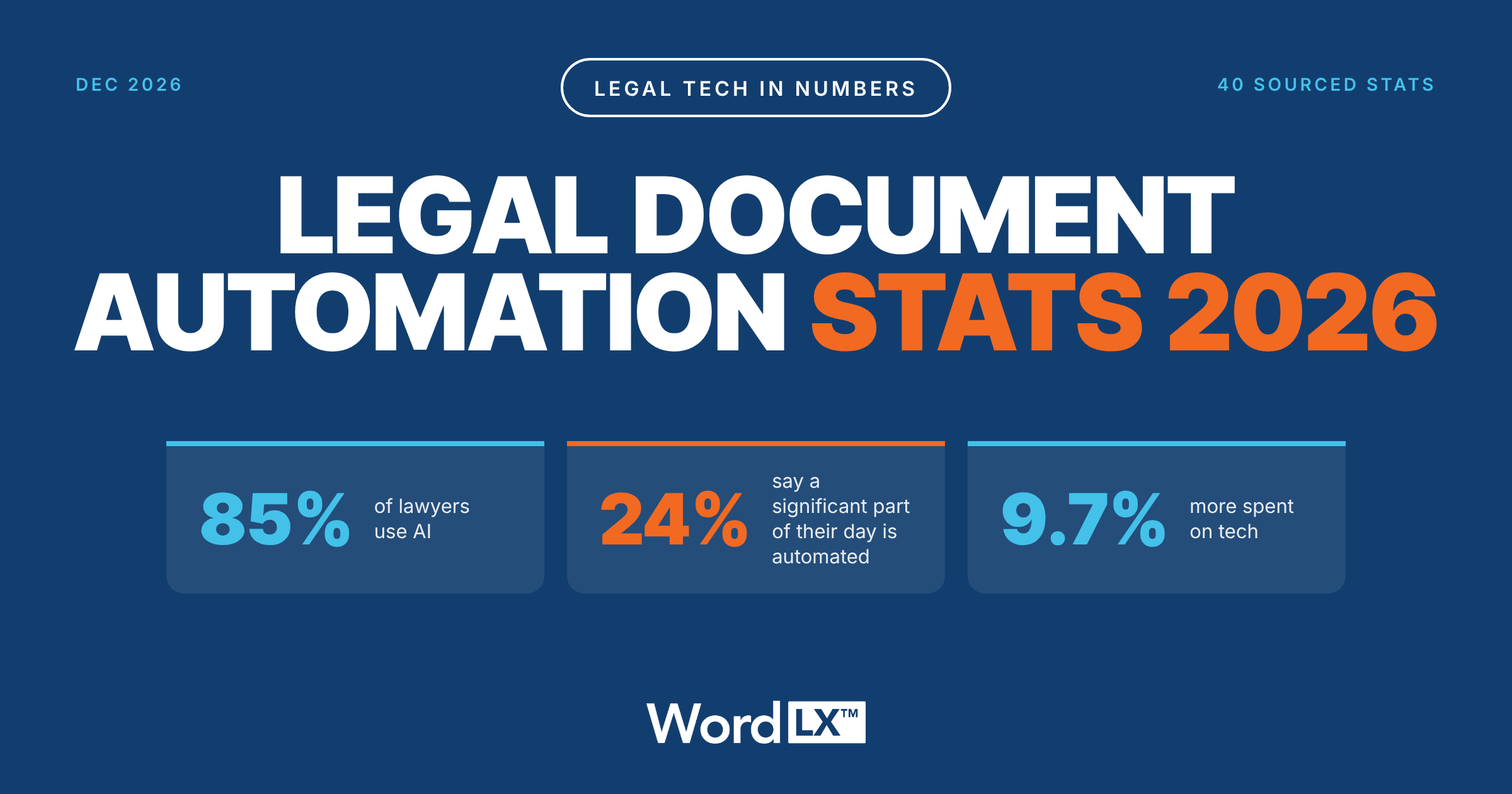
Somewhere in a 2027 budget deck right now, slide 3 says “over 90% of lawyers use AI.” Nobody in the meeting knows which survey that came from, who answered it or what counted as using AI. The number gets repeated because it sounds right, and most legal document automation statistics travel from deck to deck the same way, without a source attached.
These are the legal document automation statistics from 2026 that a firm can defend in that meeting. All 40 come from published surveys and reports, each with its source and date, plus the sample size where the source gives one. Where 2 surveys disagree, we show you both and explain why. The short version: almost every lawyer now uses AI, and far fewer say the work itself got automated.
Legal Document Automation Statistics: The Short Answer
In 2026, between 69% and 92% of legal professionals used AI at work, depending on the survey. Only 24% of lawyers said a significant part of their day was automated, and 77% said much of their work was still manual. US firms raised technology spending 9.7%, yet 54% of legal professionals said their firm offered no AI training.
Table of Contents
- Legal Document Automation Statistics at a Glance
- How Many Lawyers Use AI in 2026
- Why Legal Document Automation Statistics Disagree Between Surveys
- AI Adoption at the Firm Level
- Which AI Tools Law Firms Use
- What Lawyers Use AI For
- Legal Document Automation Statistics on Manual Work
- Time Saved and the Billable Day
- AI Accuracy and Hallucination Statistics
- AI Policy, Training and Measurement
- Legal Technology Spending and Pricing
- Clients, Billing and Consumers
- Legal Tech Funding in 2026
- What These Legal Document Automation Statistics Mean for Firms
- Where Word LX Fits
- 5 Legal Document Automation Statistics to Bring to Your 2027 Budget Meeting
- How We Checked These Legal Document Automation Statistics
- Legal Document Automation Statistics FAQ
Legal Document Automation Statistics at a Glance
These are the 10 legal document automation statistics most worth quoting. Every one is explained in full further down the page.
| Statistic | Figure | Source |
|---|---|---|
| Attorneys using an AI tool in daily practice | 83% | Bloomberg Law, June 2026 |
| Lawyers who say a significant part of their day is automated | 24% | Progress Software, July 2026 |
| Lawyers who say much of their work is still manual | 77% | Progress Software, July 2026 |
| Firms using or exploring generative AI | 94% | ILTA, September 2026 |
| Firms using or exploring Microsoft 365 Copilot | 76% | ILTA, September 2026 |
| Growth in law firm technology spending, 2025 | 9.7% | Thomson Reuters and Georgetown Law, January 2026 |
| Legal professionals whose firm offers no AI training | 54% | 8am, March 2026 |
| Professionals whose organization measures AI return on investment | 18% | Thomson Reuters Institute, February 2026 |
| Court cases involving AI hallucinations worldwide | 2,311 | Damien Charlotin database, November 18 2026 |
| Projected billable hours in an 8-hour day | 3.4 | Clio, 2026 |
How Many Lawyers Use AI in 2026
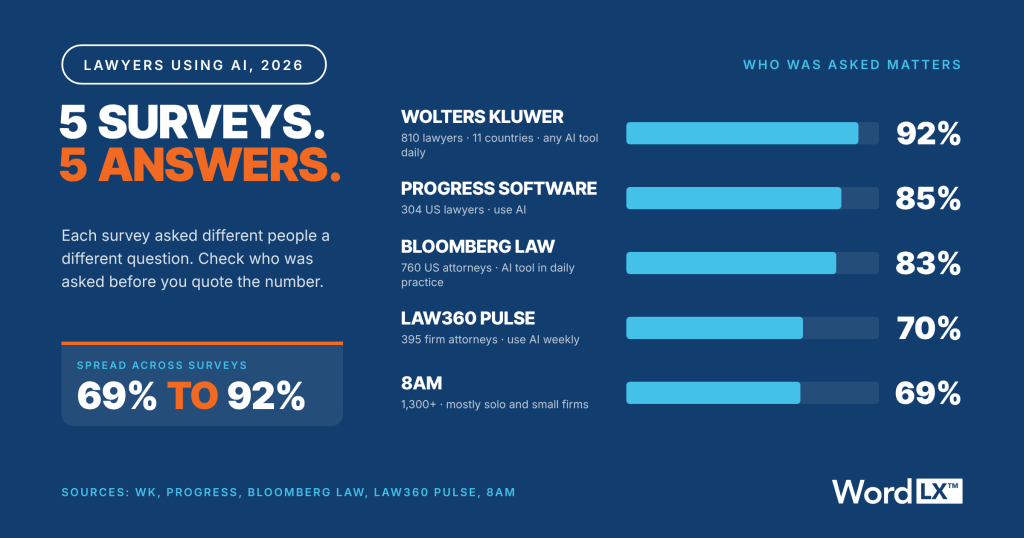
Every major survey this year found that most lawyers use AI. The figures range from 69% to 92%, because each survey asked a different group a different question.
- 83% of attorneys use some type of AI tool in their daily practice. Bloomberg Law State of Practice, 760 respondents, surveyed March 31 to April 20 2026.
- 92% of legal professionals use at least one AI tool in their daily work. Wolters Kluwer 2026 Future Ready Lawyer Survey, 810 lawyers in the US, China and 9 European countries.
- 85% of lawyers use AI for tasks such as research, summarizing documents and intake. Progress Software, State of Legal 2026, 304 US lawyers.
- 69% of legal professionals use general-purpose generative AI for work, up from 31% in 2025 and 27% in 2024. 8am 2026 Legal Industry Report, 1,300+ respondents.
- 42% use legal-specific AI tools, double the 21% from a year earlier. 8am.
- 70% of law firm attorneys use AI at least once a week. Use 3 or more times a week rose from 27% to 47% in a year. Law360 Pulse 2026 AI Survey, 506 attorneys.
Why Legal Document Automation Statistics Disagree Between Surveys
The 69% and the 92% can both be right. They measured different people. 8am’s respondents were mostly solo lawyers and small firms. Wolters Kluwer surveyed lawyers across 11 countries and counted any AI tool used daily. Law360 Pulse counted weekly use at law firms. Before you quote a figure, check who was asked and what counted as use.
| Survey | Who was asked | Sample | Fieldwork | Headline figure |
|---|---|---|---|---|
| Wolters Kluwer Future Ready Lawyer 2026 | Lawyers at firms and legal departments in the US, China and 9 European countries | 810 | August 2025 | 92% use at least one AI tool daily |
| Progress Software State of Legal 2026 | US lawyers at firms and in-house | 304 | Released July 2026 | 85% use AI |
| Bloomberg Law State of Practice | US attorneys and legal professionals | 760 | March to April 2026 | 83% use an AI tool in daily practice |
| Law360 Pulse 2026 AI Survey | US attorneys, 395 at firms and 111 in-house | 506 | November 2025 to January 2026 | 70% of firm attorneys use AI weekly |
| 8am 2026 Legal Industry Report | Legal professionals, mostly solo and small firms | 1,300+ | September to October 2025 | 69% use general-purpose AI |
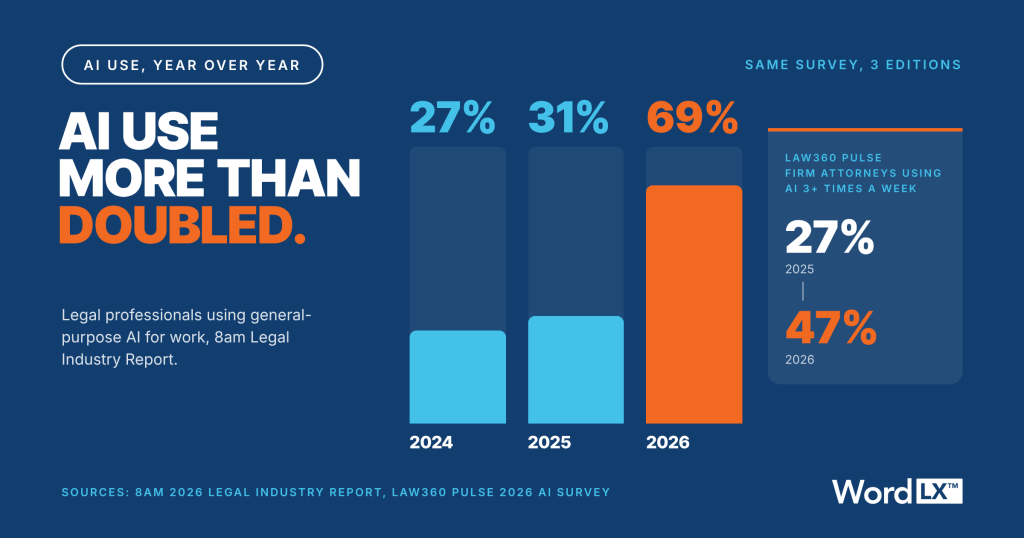
The useful comparison is change over time inside a single survey. 8am’s figure went from 31% to 69% in a year. Law360 Pulse’s figure for heavy users went from 27% to 47%. Both point the same way.
AI Adoption at the Firm Level
Individual lawyers moved faster than their firms. A lawyer can open ChatGPT on a Tuesday. A firm has to choose a tool, write a policy and train people first.
- 41% of law firms say their legal teams use generative AI, up from 28% in 2025. Thomson Reuters Institute, 2026 AI in Professional Services Report, 1,514 respondents in 27 countries.
- 34% of firms have adopted legal-specific AI tools, up from 21%. 46% of firms use general-purpose AI tools, and that rises to 58% at firms with more than 20 lawyers. 8am.
- 94% of firms say they are using or exploring generative AI, up from 80% a year earlier. ILTA 2026 Technology Survey, as reported by LawSites, 500+ firms representing 140,000 lawyers.
- 40% of firm respondents have been told by some clients to use AI on their matters and by other clients not to. Thomson Reuters Institute.
Which AI Tools Law Firms Use
The most common AI tool at law firms runs inside the software lawyers already have open all day.
- Microsoft 365 Copilot is used or explored by 76% of firms. CoCounsel and Claude follow at 44% each, then Harvey at 43%. ILTA 2026, via LawSites.
- At firms with 700 or more lawyers, the gap narrows: Copilot is at 88% and Harvey at 84%. ILTA 2026, via LawSites.
- 4 of the largest AI companies launched legal products in 5 months: Anthropic in May, Google in August, OpenAI in September and Microsoft in October 2026. LawSites.
- In the preview of Microsoft’s legal skills for Word, more than 1,800 users generated nearly 100,000 edits and kept roughly 7 in 10 suggestions, according to Microsoft. LawSites.
Copilot for Legal drafts from a firm’s approved precedents and templates inside Word. We covered what that means for firms in Microsoft Copilot for Legal.
What Lawyers Use AI For
Documents sit near the top of every list. After research, drafting is the most common job lawyers give AI.
- Among legal professionals using generative AI, 59% use it to draft briefs or memos, 55% to draft correspondence and 49% to draft contracts. Thomson Reuters 2026 AI in Professional Services Report.
- General-purpose AI tools are used to draft correspondence (58%), draft documents (43%) and work on document templates (39%). 8am, via LawSites.
- Legal-specific AI tools are used mostly for legal research (58%) and drafting documents (49%). 8am.
Drafting a document with AI still starts from something: a template, a precedent, last year’s version. If that starting point has the wrong clause or broken numbering, the draft inherits it. We wrote about the review time that follows in The AI Verification Tax.
Legal Document Automation Statistics on Manual Work
Lawyers adopted AI quickly, and most of their workflows stayed the same. These 5 numbers show how wide that gap is.
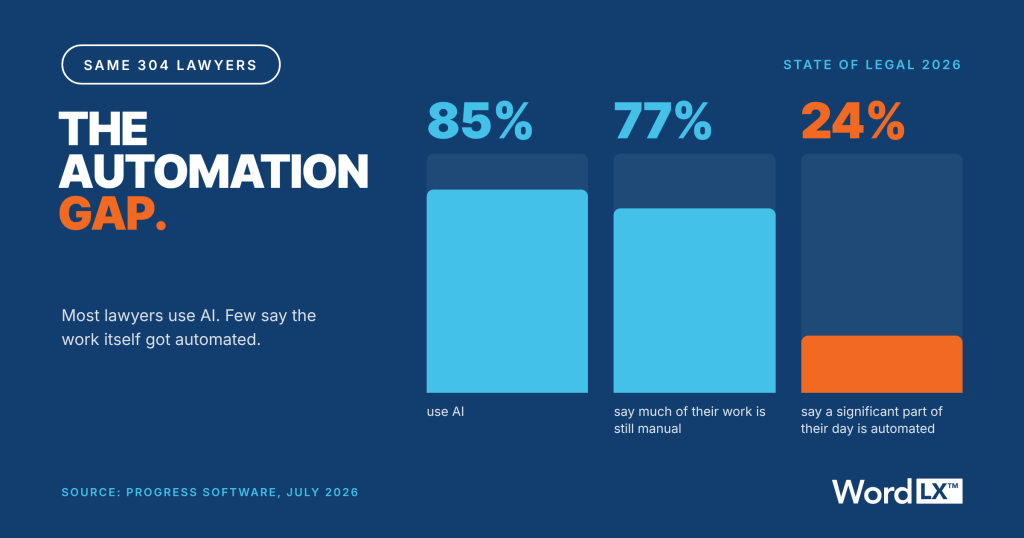
- 77% of lawyers say much of their work remains manual. Progress Software.
- 24% say a significant portion of their daily work is automated. Progress Software.
- 84% say inconsistent processes across teams or systems reduce efficiency. Progress Software.
- 73% report workflows with too many steps. Progress Software.
- 52% say they feel effective but not efficient because of manual tasks. Progress Software.
Loren Jarrett, EVP and General Manager of Digital Experience at Progress Software, put the problem plainly when the report came out: “The issue is that most firms are layering AI on top of broken, manual processes instead of rethinking how work gets done.”
All 5 of these figures come from the same 304 lawyers, which makes the comparison clean. 85% of them use AI, and 24% say a significant part of their day is automated.
Time Saved and the Billable Day
AI is saving lawyers time. The amount varies a lot, and not everyone feels it.
- Clio projects utilization will reach 42% in 2026, about 3.4 billable hours in an 8-hour day. In 2016 it was 28%, about 2.2 hours, and in 2025 it was 39%. Clio 2026 Legal Trends Report.
- 62% of legal professionals save between 6% and 20% of their time each week using AI. Wolters Kluwer.
- 38% of AI users save 1 to 5 hours a week, and 14% save 6 to 10 hours. 8am, via LawSites.
- 36% of attorneys agree AI has lightened their workload by automating routine tasks, and 39% disagree. Bloomberg Law State of Practice.
Those last 2 numbers sit close together. Roughly as many attorneys say AI hasn’t lightened their load as say it has, and part of the reason is the time spent checking what it produces.
AI Accuracy and Hallucination Statistics
The checking is real work, and courts keep seeing what happens when it gets skipped.
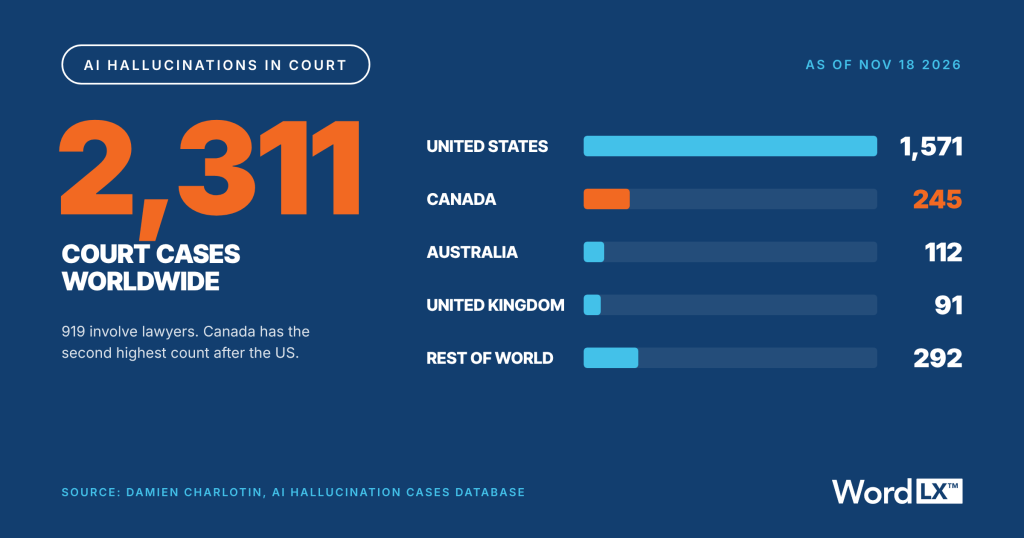
- 2,311 court cases worldwide involve AI-generated hallucinations, as of November 18 2026. 1,571 are in the US and 245 in Canada. 919 involve lawyers, and 1,326 involve self-represented litigants. Damien Charlotin, AI Hallucination Cases database.
- Leading legal research AI tools hallucinated between 17% and 33% of the time in Stanford testing. Magesh et al., “Hallucination-Free?”, Stanford RegLab and HAI. The tools were tested in 2024 and have been updated since.
- 33% of attorneys say AI has created more work because results need review. Bloomberg Law State of Practice.
- The biggest barriers to firm AI adoption are data security (46%), ethics (42%) and privilege (39%). 8am.
Canada has the second-highest count in the database, after the US. For Canadian firms, the risk is local.
AI Policy, Training and Measurement
Most firms are using AI before they have written down how it should be used.
- 54% of legal professionals say their firm offers no responsible-use AI training and has no plans to. 8am, via LawSites.
- 43% say their firm has no formal AI policy and no plans for one. 9% have a written policy that is enforced. 8am.
- 18% of professionals say their organization collects metrics on AI’s return on investment. Thomson Reuters Institute.
Nicole Black, Principal Legal Insight Strategist at 8am, summed up the year: “Across the industry, we’re seeing AI move from novelty to necessity.” The policies, training and measurement haven’t caught up yet. If you’re building that rollout plan, start with Change Management for Legal Tech.
Legal Technology Spending and Pricing
Technology budgets grew fast in 2025, and most revenue still comes from the billable hour.
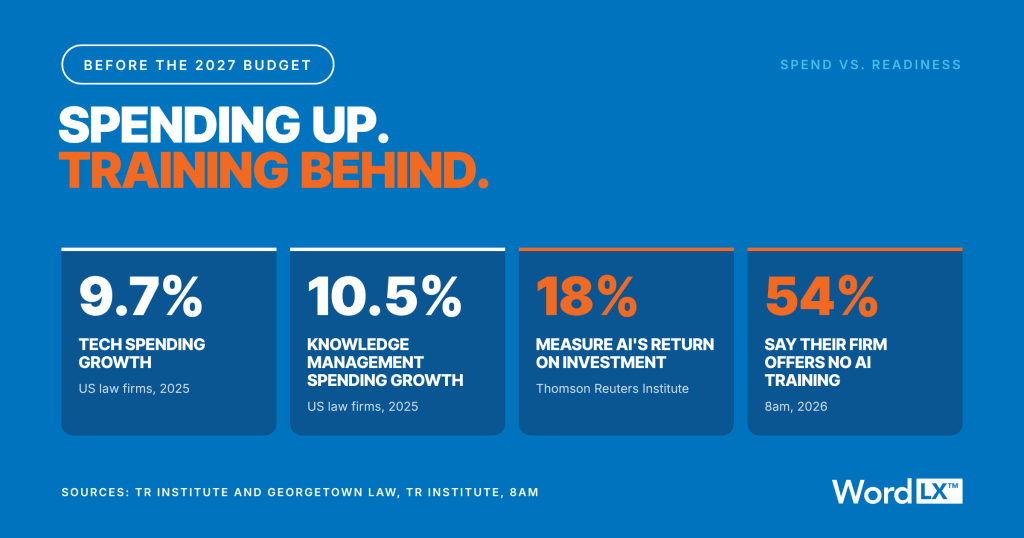
- Law firm technology spending grew 9.7% in 2025, and knowledge management spending grew 10.5%. 2026 Report on the State of the US Legal Market, Thomson Reuters Institute and Georgetown Law.
- Firms with a formal AI strategy are 3.9 times more likely to see critical benefits from AI. Same report, via LawSites.
- 90% of legal dollars still flow through standard hourly rates. Same report, via LawSites.
- Am Law 100 standard rates passed $1,000 an hour in 2025. Other firms averaged around $600. Same report, via LawSites.
At $600 an hour, every hour of document clean-up that can’t be billed is $600 of capacity spent. We broke down what that means for next year’s plan in The 2027 Law Firm Technology Budget, and what automation itself costs in Legal Document Automation Cost.
Clients, Billing and Consumers
Firms say little to clients about AI. Consumers are already using it.
- 41% of respondents say their organization doesn’t disclose AI use on client bills. Bloomberg Law State of Practice.
- 46% of consumers would consult AI before contacting a lawyer, and 24% of US adults have already used AI to answer a legal question. Clio 2026 Legal Trends Report.
A client who has already asked an AI about their matter may arrive with expectations set by what it told them, including how fast a first draft should take.
Legal Tech Funding in 2026
Legal tech funding set a record in 2025.
- Legal tech startups raised a record $4.6 billion in 2025 and more than $2.2 billion in 2026 by late August, according to Crunchbase. Harvey alone raised $550 million at a $15.5 billion valuation in September, up from $11 billion in March, per its announcement.
For a law firm, that funding shows up as AI features arriving inside software it already pays for, and as more vendors asking for a demo. Every one of those tools still drafts from the firm’s own templates and precedents.
What These Legal Document Automation Statistics Mean for Firms
Side by side, these legal document automation statistics show a gap between AI use and automated work. 85% of lawyers use AI, 24% say a significant part of their day is automated, and 84% say inconsistent processes slow them down.
Most of that inconsistency lives in documents. Each practice group keeps its own engagement letter. Templates carry old clauses. Numbering breaks when someone pastes from a precedent. An AI tool drafting from those files produces a faster version of the same problems, which is why 33% of attorneys say AI created more review work.
The fix starts before the AI: one approved set of templates and clauses, with consistent Styles and numbering, that every lawyer and every tool drafts from. That work is document automation. We explained how it differs from AI drafting in AI Drafting vs Document Automation, and how to build it in Word in How to Automate Legal Documents in Microsoft Word.
Free download
The 2026 Legal Tech Stats Sheet
The 12 numbers worth bringing to a 2027 budget meeting on one page, each with its source and date, plus 5 questions to ask before you approve next year’s technology spend.
Download the stats sheet (PDF)Where Word LX Fits
Word LX works inside Microsoft Word, where lawyers draft and where Copilot for Legal now drafts too. It keeps one managed library of firm templates and clauses, so a clause updated once is current everywhere. It applies the firm’s Styles, numbering and branding to every document, and fills client and matter details once through document assembly.
That gives AI tools and lawyers the same approved starting point. When a Copilot draft or an associate’s first pass begins from a Word LX template, the clauses are current and the formatting holds.
Word LX also connects with iManage and NetDocuments, so templates live alongside the documents they produce. If your firm is planning its 2027 AI rollout, the templates are the place to start.
5 Legal Document Automation Statistics to Bring to Your 2027 Budget Meeting
If you only take 5 numbers into the room, take these.
- 85% and 24%. Most lawyers use AI, and few say their work is automated. That gap deserves its own line in the budget.
- 9.7%. The average firm grew technology spending this much in 2025. Ask what your share bought.
- 54%. Firms offering no AI training. Ask whether yours is one of them.
- 18%. Organizations measuring AI return on investment. Agree on a measure before you renew a licence.
- 2,311. Court cases involving AI hallucinations, 245 of them in Canada. Ask who checks AI output before it leaves the firm.
How We Checked These Legal Document Automation Statistics
We checked each legal document automation statistic on November 19 2026 against the publisher’s own report, press release or web page. 2 sources are member-only or paywalled: the ILTA 2026 Technology Survey and parts of the State of the US Legal Market report. For those, we cite LawSites’ reporting and say so next to the figure.
We left out widely shared figures we could not trace to a published survey with a sample and a date. The hallucination case count changes every week, so check the Charlotin database for the current figure.
Survey samples differ in size, country and firm type. When you compare years, use the same survey for both.
Legal Document Automation Statistics FAQ
What percentage of lawyers use AI in 2026?
Between 69% and 92% of lawyers use AI in 2026, depending on the survey. Bloomberg Law found 83% of attorneys use an AI tool in daily practice. Wolters Kluwer found 92% across 11 countries, Progress found 85% of US lawyers and 8am found 69%, mostly among solo and small firms. The gap comes from who each survey asked.
How many law firms use document automation software?
No 2026 survey gives a clean percentage of law firms using document automation software. The closest figures: 24% of lawyers say a significant part of their daily work is automated (Progress), 34% of firms have adopted legal-specific AI tools (8am), and 39% of AI users apply it to document templates (8am).
How much time does legal AI save?
Legal AI saves most users a few hours a week. Wolters Kluwer found 62% of legal professionals save 6% to 20% of their time each week, and 8am found 38% save 1 to 5 hours. Results vary: in Bloomberg Law’s survey, 36% said AI lightened their workload and 39% said it did not.
How often does legal AI hallucinate?
Legal AI hallucinates often enough that every output needs checking. Stanford researchers found leading legal research tools hallucinated 17% to 33% of the time in 2024 testing. As of November 18 2026, the Charlotin database had logged 2,311 court cases involving AI hallucinations worldwide, including 245 in Canada.
How much are law firms spending on technology in 2026?
Law firm technology spending grew 9.7% in 2025. The 2026 Report on the State of the US Legal Market also found knowledge management spending grew 10.5%. Firms with a formal AI strategy were 3.9 times more likely to see critical benefits from AI.
Why do legal AI adoption surveys give different numbers?
Legal AI adoption surveys give different numbers because they ask different people different questions. 8am surveyed mostly solo and small firms, Wolters Kluwer covered 11 countries and counted any daily AI tool, and Law360 Pulse measured weekly use at firms. For the clearest picture from any set of legal document automation statistics, compare change over time within one survey.
Before the 2027 rollout
Give your lawyers and your AI the same approved starting point
Bring one template your firm uses every week to a 30 minute walkthrough. We’ll show you how Word LX keeps one approved version of it, with current clauses, consistent Styles and numbering that holds, all inside Microsoft Word.
Book a Word LX demo