
Law firms are hearing two big promises right now. AI will draft your documents for you. And automation will eliminate your repetitive work. Both promises contain real truth. But they describe two very different technologies that solve two very different problems.
Understanding the real difference between AI drafting vs document automation matters because firms that confuse the two tend to buy the wrong tools, invest in the wrong workflows, and end up more frustrated than when they started. The firms getting the best results in 2026 are the ones that understand what each technology does well, where each one falls short, and why most practices need both working together.
Table of Contents
- Why the Confusion Between AI Drafting and Document Automation
- What AI Drafting Actually Does for Law Firms
- What Document Automation Actually Does for Law Firms
- AI Drafting vs Document Automation: A Side-by-Side Comparison
- When AI Drafting Is the Right Tool
- When Document Automation Is the Right Tool
- Why Most Law Firms Need Both
- Getting Started: A Practical Approach
- Frequently Asked Questions
Why the Confusion Between AI Drafting and Document Automation Exists
The legal technology market has grown crowded. Vendors use terms like “AI-powered,” “intelligent automation,” and “smart drafting” interchangeably, even when their products do fundamentally different things. That makes the AI drafting vs document automation question harder to answer than it should be.
Adding to the confusion, AI usage by law firm professionals increased 315% from 2023 to 2024. That kind of rapid adoption creates pressure to invest in “AI” without a clear understanding of what specific problem AI is solving. Many firms hear about AI drafting tools and assume they replace every other document tool they use. They don’t.
At the same time, document automation has been around for decades, and some firms dismiss it as outdated technology. That’s a mistake too. As Gavel CEO Dorna Moini said publicly when her company launched new automation workflows alongside its AI product: rules-based automation remains as essential as ever in the age of AI.
The truth is simpler than the marketing suggests. AI drafting and document automation are complementary technologies that do different jobs. Understanding AI drafting vs document automation starts with understanding what each one actually does.
What AI Drafting Actually Does for Law Firms
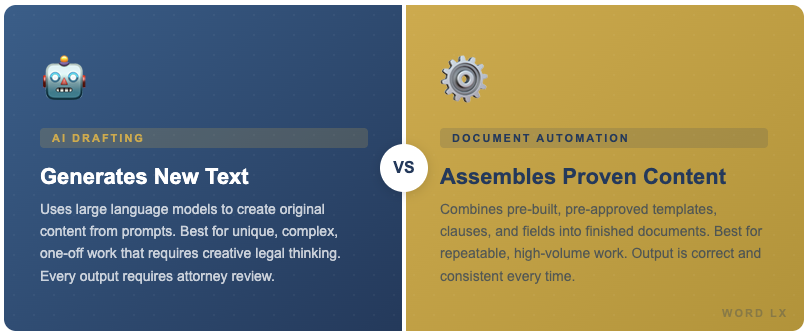
AI drafting tools use large language models to generate text. You give the tool a prompt, context, or an existing document, and it produces new content. Depending on the tool, this can include drafting contract clauses, generating first versions of memos, suggesting alternative language during redlining, summarizing lengthy documents, or translating legal content between languages.
The best AI drafting tools for legal work are purpose-built for the profession. They understand legal terminology, can reference a firm’s own clause libraries and past work, and produce output that sounds like it came from an attorney rather than a chatbot. 82% of firms using AI reported greater productivity, with many saving several hours per week on drafting and research tasks.
The strengths of AI drafting are real. It excels at creative work, at generating a starting point when you’re facing a blank page, and at handling one-off or unusual documents that don’t follow a repeatable pattern. When a lawyer needs to draft a unique response to a novel legal argument, AI can speed up the process significantly.
But AI drafting also comes with real limitations. The most important one: AI generates probable text, not guaranteed text. Every AI-drafted document requires careful attorney review because the model can introduce subtle errors, outdated references, or language that sounds right but carries unintended legal implications. This review step is non-negotiable, and firms that skip it are taking on serious risk.
What Document Automation Actually Does for Law Firms
Document automation takes a completely different approach. Instead of generating new text, automation assembles documents from pre-built, pre-approved components. Templates with embedded logic, locked formatting, standardized clauses, and dynamic fields combine to produce a finished document that is correct every time it’s generated.
When an attorney needs to produce a standard engagement letter, a confidentiality agreement, a pleading shell, or a client correspondence template, document automation handles it without generating a single word of new text. The content already exists. It has already been reviewed and approved. The automation simply puts it together in the right structure with the right client-specific details populated automatically.
This is the fundamental difference in the AI drafting vs document automation comparison. Automation doesn’t guess. It doesn’t hallucinate. It doesn’t produce content that needs verification against a knowledge base. Where automation assembles the same letter in under two minutes, that letter will be formatted correctly, use approved language, include the right signature block, and comply with your firm’s standards every single time.
The strength of document automation is consistency and speed for repeatable work. For the documents your firm produces over and over again (the ones that account for the majority of your total document volume) automation is faster, safer, and more reliable than any AI tool.
AI Drafting vs Document Automation: How They Compare
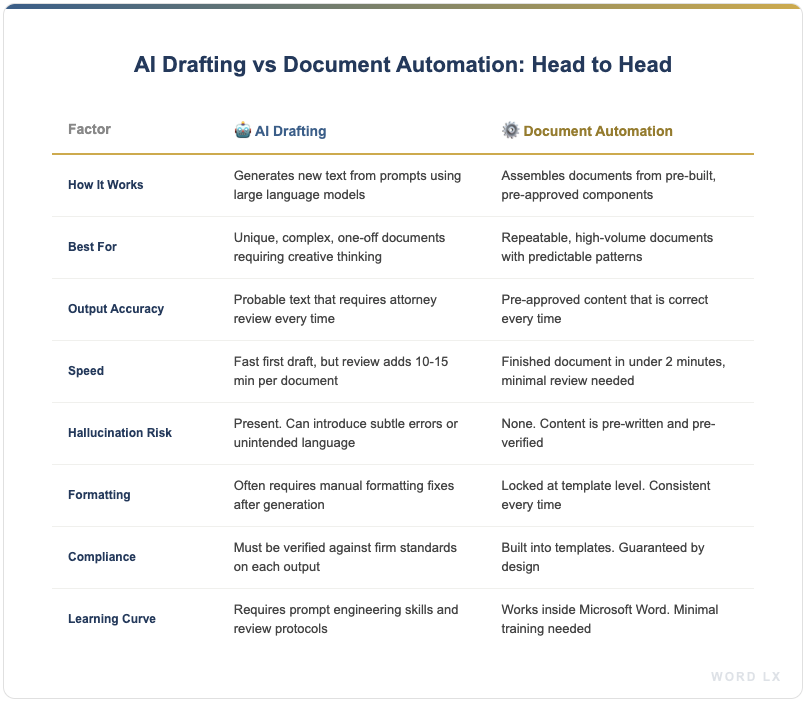
The clearest way to understand AI drafting vs document automation is to look at what happens when each technology handles the same task.
Take a standard engagement letter. An AI drafting tool can generate a solid first draft in about 30 seconds. But that draft needs review. Does it include the right fee language? Is the scope of representation described accurately? Does the formatting match your firm’s standards? Are the disclaimer paragraphs using your approved wording? A lawyer still needs to check every element, adjust the language, fix the formatting, and verify that nothing was added or omitted. That review process can take 10 to 15 minutes, sometimes longer.
A document automation system produces the same engagement letter in under two minutes. The template is pre-built with your firm’s approved language. The fee structure populates from matter data. The formatting is locked. The signature block, disclaimers, and jurisdictional language are all embedded. The attorney reviews the final product in a fraction of the time because the content was pre-approved at the template level.
Now take a different scenario: a lawyer needs to draft a detailed response to a novel regulatory inquiry. There’s no template for this. The facts are unique, the legal arguments are complex, and the document requires creative legal thinking. AI drafting is genuinely useful here. It can generate a structured first draft, suggest relevant precedent language, and help the attorney organize their arguments faster than starting from a blank page.
This comparison reveals the core principle of AI drafting vs document automation: automation is your foundation for the work you do repeatedly, and AI is your accelerator for the work that requires original thinking. Confusing one for the other leads to the wrong tool doing the wrong job.
When AI Drafting Is the Right Tool
AI drafting earns its value in situations where no template exists, where the content is unique to the matter, or where the attorney needs creative assistance. Specific scenarios where AI drafting shines include first drafts of complex contracts with unusual terms, research memos that synthesize multiple authorities, client communications that require a particular tone or strategy, redlining suggestions during contract negotiations, and document summaries for large files or transaction due diligence.
AI is also valuable for brainstorming. When a lawyer is stuck on how to frame an argument or wants to explore alternative clause language, an AI tool can generate options in seconds. This kind of creative acceleration is something document automation simply cannot do.
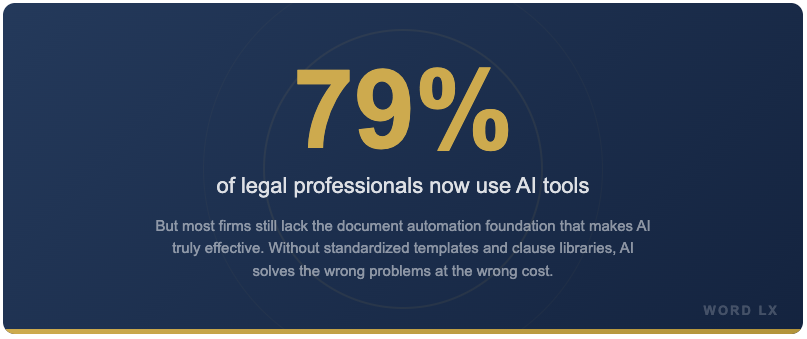
The key to using AI drafting well is building review into the workflow. 79% of legal professionals now use AI tools in some capacity, and the firms getting the best results are the ones that treat AI output as a starting point, never a finished product. Every AI-generated document should go through the same quality check you would apply to a first-year associate’s work.
When firms invest in AI drafting tools with proper review protocols, the productivity gains are real and measurable. The risk only appears when firms trust AI output without verification.
When Document Automation Is the Right Tool
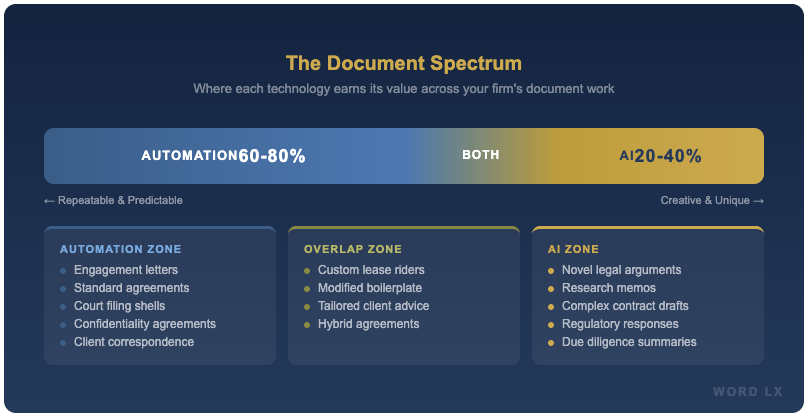
Document automation is the right tool for any document your firm produces more than a handful of times per month. This includes engagement letters, standard agreements, court filing shells, client correspondence, confidentiality agreements, retainer letters, demand letter frameworks, and any document where the structure, language, and formatting follow predictable patterns.
This category of documents usually represents 60% to 80% of a firm’s total document output. That means the majority of your firm’s document work is better served by automation than by AI. The invisible costs that accumulate from handling these documents manually are substantial, often adding up to more than an hour per attorney per day.
Document automation is also the right choice when compliance and brand consistency matter. Every document that leaves your firm represents your brand. When templates are standardized with firm-wide document standards, every letter, every agreement, and every filing looks professional and consistent regardless of which attorney or assistant produced it.
Automation also eliminates one of the most common sources of daily frustration in legal practice: formatting that breaks every time a document gets edited by multiple people. When styles, numbering, and fonts are locked at the template level, that entire category of problems disappears.
Why Most Law Firms Need Both AI Drafting and Document Automation
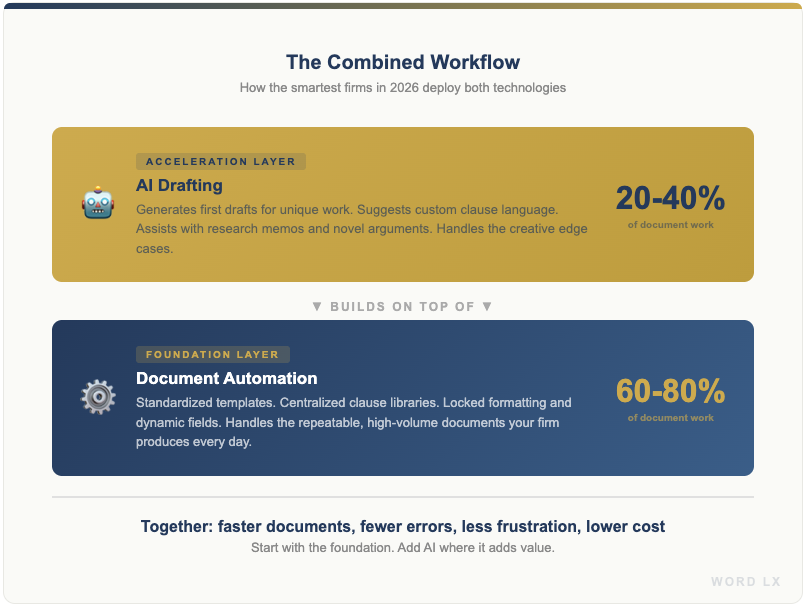
This is where the AI drafting vs document automation conversation gets practical. The answer for most firms is not one or the other. The answer is both, deployed strategically for the tasks each one handles best.
Think of your firm’s document work as two buckets. The first bucket is your repeatable, high-volume work: the documents you produce dozens or hundreds of times per year. This bucket needs automation. Templates, clause libraries, dynamic fields, locked formatting, and centralized administration. Applying AI to this bucket adds unnecessary review overhead to documents that should already be correct.
The second bucket is your creative, complex, one-off work: the documents that require original legal thinking and don’t fit a standard template. This bucket benefits from AI. First-draft generation, research assistance, clause suggestions, and language alternatives. Applying automation to this bucket doesn’t work because these documents are different every time.
The smartest firms in 2026 are building workflows where automation handles the foundation and AI handles the edge cases. For example, a firm might use document automation to generate a standard commercial lease agreement with all the approved boilerplate, then use an AI drafting tool to suggest custom rider language for an unusual tenant provision. The automation ensures the base document is compliant and consistent. The AI accelerates the creative work on top of it.
This combined approach saves more time than either technology alone. Automation eliminates the 60% to 80% of document work that follows predictable patterns. AI accelerates the remaining 20% to 40% that requires original thinking. Together, they give attorneys a dramatically better daily experience with document creation, which is something that directly impacts job satisfaction and digital transformation at your firm.
Getting Started: A Practical Approach to AI Drafting vs Document Automation
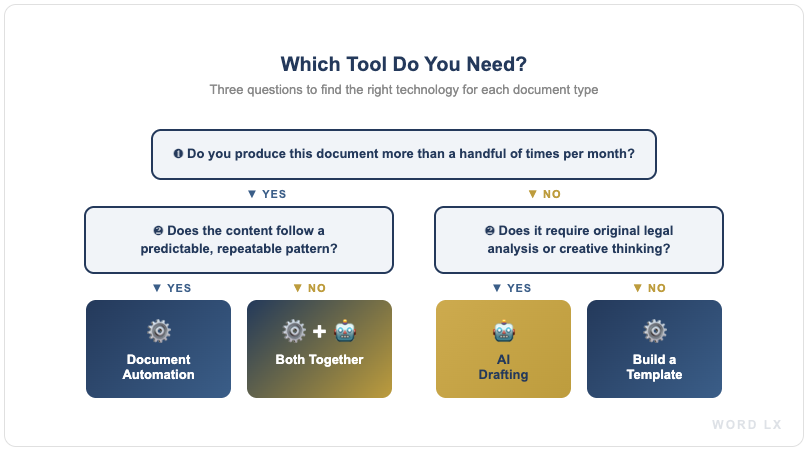
If your firm is trying to decide where to invest first, start with the documents that cause the most daily friction. Audit your current document workflows by identifying the ten documents your firm produces most frequently. For most firms, the majority of those documents will be strong candidates for automation.
Once your automation foundation is in place (standardized templates, centralized clause libraries, locked formatting, and dynamic fields) then evaluate where AI drafting tools can add value on top of that foundation. This order matters. Firms that jump straight to AI without fixing their automation foundation end up using expensive AI tools to solve problems that templates could have handled for a fraction of the cost.
A useful practical guide to evaluating tools will help you think through which technology fits which workflow. The goal is a document ecosystem where automation handles the predictable and AI handles the creative, with attorneys spending their time on the work that actually requires a law degree.
The firms that get this balance right will have a significant competitive advantage. Their documents will be produced faster, with fewer errors, at lower cost, and with less daily frustration for the attorneys creating them. That combination is hard to beat.
Frequently Asked Questions
AI drafting uses large language models to generate new text based on prompts, context, or existing documents. It creates original content that requires attorney review for accuracy and completeness. Document automation uses pre-built templates with embedded logic, approved clauses, and dynamic fields to assemble documents from verified components. Automation does not generate new text. It assembles proven content into a consistent, formatted document. The core difference is that AI creates while automation assembles. AI is ideal for unique and complex work, while automation is ideal for repeatable, high-volume documents. Most law firms benefit from using both technologies together.
Yes, but with appropriate guardrails. AI drafting tools can significantly accelerate creative legal work like generating first drafts of complex contracts, summarizing large document sets, and suggesting alternative clause language during negotiations. The ABA Law Technology Today reports that 82% of firms using AI have seen productivity improvements. The critical requirement is building attorney review into every AI-assisted workflow. AI-generated content should always be treated as a first draft that requires verification, not as finished work product. Firms should also evaluate whether AI is the right tool for the specific task. For repeatable documents like engagement letters and standard agreements, document automation is typically faster, cheaper, and more reliable than AI.
Document automation for law firms is a technology that turns your approved document templates into smart, reusable systems. Instead of starting from a blank page or copying from old files, attorneys select a template, answer a few questions or pull data from existing systems, and the automation produces a correctly formatted, compliant document in minutes. Key features include standardized templates with locked formatting, centralized clause libraries, dynamic fields that populate client and matter information automatically, and firm-wide deployment so every attorney has access to the same current versions. Document automation is most valuable for the 60% to 80% of documents that follow repeatable patterns, where consistency, speed, and accuracy matter more than creative drafting.
Not effectively. AI and document automation solve different problems, and using AI for work that automation handles better creates unnecessary risk and inefficiency. AI excels at generating new text and creative problem-solving, but it cannot guarantee that every output will use your firm’s exact approved language, follow your formatting standards, or comply with your internal policies. Those guarantees come from automation. An AI tool might draft an excellent engagement letter, but it requires review to ensure it matches your firm’s standards. An automated template produces the same engagement letter instantly, correctly, every time, because the content was pre-approved at the template level. The most efficient firms use automation as the foundation for repeatable work and AI as an accelerator for complex or creative work.
The best document automation tools for law firms integrate directly with Microsoft Word (since that is where most legal work happens), offer centralized template management, include clause libraries, support dynamic fields and conditional logic, and allow firm-wide deployment with centralized administration. When evaluating tools, prioritize solutions that lock formatting at the template level to prevent the kind of style and numbering issues that waste attorney time. Also look for tools that work within your existing environment rather than requiring attorneys to learn a separate platform. The easier the tool is to adopt, the more likely your team is to actually use it.
AI drafting is safe when used with proper review protocols. The primary risks are hallucination (AI generating plausible but inaccurate content), citation errors, and subtle misstatements of legal principles. Legal-specific AI tools reduce these risks compared to general-purpose tools like ChatGPT, but they do not eliminate them entirely. Every AI-drafted legal document should be reviewed by a qualified attorney before delivery or filing. Firms should also establish clear policies about which types of documents can use AI assistance and which should rely on pre-approved automation. For high-volume documents where accuracy and consistency are paramount, document automation is typically the safer and more efficient choice.
Conclusion
The AI drafting vs document automation question has a clear answer for most law firms: you need both, doing different jobs.
Document automation is your foundation. It handles the high-volume, repeatable documents that make up the majority of your firm’s output, producing them faster, more consistently, and with fewer errors than any other approach. AI drafting is your accelerator. It helps attorneys work faster on creative, complex, and unique documents that require original legal thinking.
The firms that get this balance right will produce better documents in less time with less daily frustration. The firms that confuse the two will keep spending money on tools that solve the wrong problems. Start with automation. Add AI where it adds genuine value. And give your attorneys a document experience that lets them focus on the work that requires a law degree.
Ready to build your document automation foundation?
Word LX gives law firms smart templates, clause libraries, and formatting controls that work directly inside Microsoft Word. It’s the automation layer that makes everything else (including AI) work better. Book a demo to see how Word LX can streamline your firm’s most common documents.