
A partner asks the firm’s new AI tool for a first draft of a shareholders’ agreement. Ninety seconds later, a clean, well-structured, confident document appears on screen. It looks finished. It reads like something a senior associate would have spent half a day on. Verifying AI-generated legal documents like this one is where a firm’s real time now goes.
Then the real work starts. Every defined term has to be checked against the deal, every cross-reference has to be confirmed, and every clause that looks borrowed has to be traced back to a source, because a clause that reads perfectly can still be the wrong clause. And every citation, if the document is headed for a court, has to be read in full and verified, because a fabricated case that looks real is now one of the most expensive mistakes a firm can make.
The draft took 90 seconds. The verification took three hours. That gap has a name, and most firms have not put it on the books yet.
This piece explains what the verification tax is, why it grows even as AI saves drafting time, the five places it hides in legal work, and why the size of the bill comes down to one thing most firms have not addressed: whether the content the AI draws from is governed.
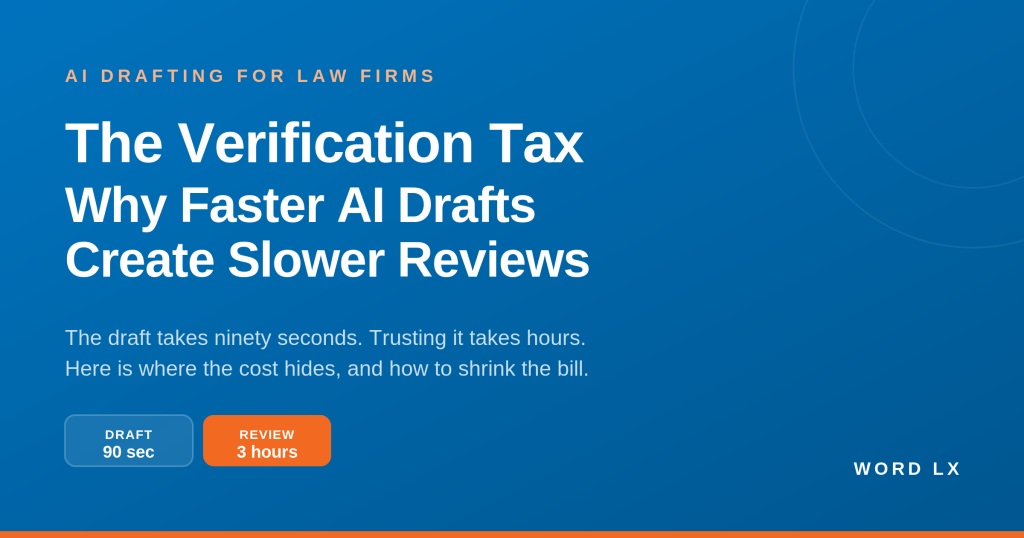
Table of Contents
- What the Verification Tax Is
- Drafting Got Faster. Review Got Heavier.
- The 5 Places the Verification Tax Hides
- Why the Tax Is Heaviest When Content Is Ungoverned
- Verification Is Now a Professional Obligation
- The Fix That Lowers the Tax
- A 60-Second Pre-Send Verification Audit
- FAQ
What the Verification Tax Is
The verification tax is the time a lawyer spends verifying AI-generated legal documents before they can leave the building, confirming the output is actually correct. It is the review step that did not exist when the same lawyer drafted from a trusted template by hand.
Here is why it is easy to miss. When a lawyer drafts from the firm’s approved precedent, trust is built into the source. The template was vetted once, by someone who owned it, and every document that starts from it inherits that vetting. When a lawyer starts from an AI draft, none of that trust carries over. The output is new every time, assembled from patterns the lawyer cannot see, and it has to be earned back line by line.
So the firm trades a known, front-loaded cost, maintaining good templates, for a recurring, per-document cost, verifying fresh output over and over. The drafting line on the invoice gets shorter. A new line appears underneath it, and that line grows with every document the firm produces.
Drafting Got Faster. Review Got Heavier.
The time savings from AI are real. In the 2026 Wolters Kluwer Future Ready Lawyer survey, 62% of legal professionals reported weekly time savings of 6% to 20%, and firms describe roughly a one-third reduction in the time spent on document review, research, and drafting. A routine vendor agreement that used to take a day can move through a first pass in under thirty minutes.
None of that is in dispute. The problem is what the headline number hides. The savings show up at the drafting stage, where they are easy to see and easy to celebrate. The new cost shows up at the review stage, where it is quieter and lands on more expensive people.
A first-year can produce an AI draft in minutes. Only a senior lawyer can confirm that the indemnity language is right, that the governing-law clause matches the deal, and that no citation was invented. The faster and more polished the draft, the more careful that review has to be, because polish is exactly what makes a wrong document hard to catch. More than half of firms, 54% in the 2026 Legal Industry Report, have provided no training on responsible AI use, which means the review burden often falls on lawyers who were never shown where the output tends to fail.
This is the same compounding pattern we described in Why “Fixing It Later” Costs Law Firms More Than They Think. A small cost, repeated across every lawyer and every document, becomes a standing tax on the firm. Instead of removing that tax, AI moved it downstream and made it bigger.
The 5 Places the Verification Tax Hides

1. Fabricated citations and quotes
The most public failure. AI invents cases, misquotes real ones, and cites statutes that do not say what it claims. As of 2026, public trackers have logged more than 1,400 court decisions worldwide where someone relied on AI-invented material. In one Nebraska appeal, 57 of 63 citations in a single brief were defective, including 20 hallucinated cases. Catching this requires reading every citation in full, every time.
2. Borrowed clauses that are plausible but wrong
Harder to see than a fake citation, and more common. AI assembles a clause that reads beautifully and belongs to a different kind of deal. A limitation-of-liability cap calibrated for a software license lands in a construction contract. The language is clean, the logic is internally consistent, and it is the wrong clause. Only substantive review catches it.
3. Silent inconsistencies with firm standards
The draft uses a defined term the firm retired two years ago, a governing-law convention the firm does not follow, or formatting that does not match the house style. None of it is wrong on its face. All of it signals to a client or a counterparty that the document was not built the firm’s way, and reconciling it by hand takes time no one scheduled.
4. Source contamination
This is the one that keeps CIOs awake. General-purpose AI drafts from whatever content it can reach. If a tool has access beyond what a matter should allow, it can pull language across a wall it was never meant to cross. 73% of enterprises discover critical data-exposure risks after deploying Copilot. In a law firm, a single misconfiguration becomes a privilege and confidentiality problem, and confirming it did not happen is part of the review.
5. The “looks finished” trap
The most insidious cost is the one the polish itself creates. A handwritten first draft looks like a first draft, so it invites scrutiny. An AI draft looks final, so it lowers the reader’s guard at exactly the moment it should be raised. The verification tax is highest precisely because the document does not look like it needs verifying.
Why the Tax Is Heaviest When Content Is Ungoverned

Here is the part most firms miss. The size of the verification tax is not fixed. It scales directly with how governed the AI’s source content is.
Point AI at approved templates and a current, owned clause library, and most of what it produces is drawn from language the firm has already vetted. The review shrinks to confirming the AI applied good content correctly. That is a real check, but a fast one.
Point the same AI at a shared drive full of a decade of old deal files, retired precedents, and one power user’s personal macros, and every draft is suspect from the first line. The review expands to confirming the AI did not build on content the firm would never have approved in the first place. That is a slow, line-by-line check, and it is where the hours go.
The tax, in other words, is mostly a symptom. The underlying condition is an ungoverned document environment. We made the broader version of this case in AI Drafting vs Document Automation: What Law Firms Actually Need and in How to Enforce Firm-Wide Document Standards Without Policing Lawyers. AI drafting raises the stakes on both. The firms getting the most from AI are the ones that did the unglamorous work first.
Verification Is Now a Professional Obligation
Even if a firm did not care about the wasted hours, the verification step is no longer optional. The rules have caught up.
Courts have been direct. “I used AI” is not a defense to a Rule 11 violation, and failing to check an AI-generated citation is now treated as a failure of reasonable inquiry. As of June 1, 2026, roughly 113 active standing orders govern how attorneys must disclose and verify AI use in filings, and the California Bar has proposed a rule that would require lawyers to verify every AI output. Sanctions have followed the failures, from four-figure fines into the tens of thousands, with one firm ordered to pay $31,100 over fabricated citations.
Read together, these send one message. Verification is now part of the standard of care. The lawyer who signs the document owns every word in it, whether a person or a model produced the first draft. That makes the verification tax a cost the firm has to pay. The only question left is how to make it as small as possible.
The AI Draft Verification Checklist
The pre-send pass every AI-assisted document should clear before it leaves the firm. 8 checks across citations, substance, source, and sign-off, on one printable page.
The Fix That Lowers the Tax
You cannot remove the step of verifying AI-generated legal documents, but you can shrink it, and you do that by governing the content the AI draws from before the first prompt is ever typed.
That means a single controlled home for approved templates, so lawyers and AI both draft from current language instead of last year’s deal file. It means a clause library that is owned and kept current, so the AI assembles from vetted building blocks. It means styles and numbering that hold to a firm-wide standard, so output does not drift the moment a document changes hands. And it means those standards are enforced inside Microsoft Word, where lawyers actually work, rather than living in a policy document no one opens.
This is what Word LX is built to do. It sits inside Word as a ribbon-level add-in and manages templates, clause libraries, numbering, and styles at the firm level, so the content your lawyers draft from, and the content your AI draws from, is the content the firm has already approved. When the source is trustworthy, verification stops being a line-by-line search for problems and becomes a quick confirmation that good inputs produced a good draft.
AI is a mirror for your content. Governed content is how you make the reflection worth trusting, and how you keep the verification tax from quietly growing into the most expensive line item in your document workflow.
A 60-Second Pre-Send Verification Audit
Before any AI-assisted document leaves the firm, run this quick pass:
- Read every citation in full. Confirm each case, statute, and quote exists and says what the draft claims. No exceptions.
- Trace every clause that looks borrowed. Ask whether it belongs to this deal, not just whether it reads well.
- Check defined terms and cross-references. Confirm they resolve to the right place and match the firm’s conventions.
- Confirm the source. Verify the AI drew only from content it was allowed to reach for this matter.
- Match it to the house standard. Styles, numbering, and defined-term conventions should look like the firm built it, because a partner’s name is on it.
If steps one through four take more than a minute or two on a routine document, that is the verification tax showing you your source content needs governing.
Frequently Asked Questions
It saves real time at the drafting stage, with surveys reporting weekly savings of 6% to 20% and roughly a one-third cut in review, research, and drafting time. The catch is a new verification step on every AI-assisted document that offsets part of the gain. The net benefit depends on how small you can keep that verification step.
It is the time a lawyer must spend confirming an AI-assisted document is correct before it can be used or filed. It replaces the built-in trust that comes from drafting off a vetted template, and it recurs on every document rather than being paid once.
AI produces fresh, polished output assembled from patterns the lawyer cannot see. It can fabricate citations, borrow clauses from the wrong context, drift from firm standards, and pull from content it should not reach. The polish makes those errors harder to spot, not easier.
Yes. Courts have held that “I used AI” is not a defense to a Rule 11 violation, more than 100 standing orders now govern AI disclosure and verification in filings, and at least one state bar has proposed requiring verification of every AI output. Verification is part of the standard of care.
Verifying AI-generated legal documents gets faster when you govern the content the AI draws from. Approved templates in one place, an owned and current clause library, and firm-wide styles and numbering enforced inside Word all shrink the review surface, so verification becomes a fast confirmation instead of a slow search for problems.