


Law firm attorney retention is one of the most expensive problems in the legal industry. Replacing a single attorney costs between $200,000 and $500,000 when you factor in recruiting, onboarding, lost productivity, and the disruption to client relationships.
Most firms respond to attrition with the same playbook: raise compensation, offer flexible schedules, invest in wellness programs. Those things matter. But they rarely address one of the most persistent daily sources of frustration for attorneys: the hours spent on tedious, repetitive document work that has nothing to do with practicing law.
The firms that achieve the strongest law firm attorney retention are the ones that fix the systems driving frustration, not just the symptoms of it. And for many firms, document workflows are one of the biggest unaddressed systems problems hiding in plain sight.
Table of Contents
- The Real Numbers Behind Attorney Attrition
- What’s Actually Driving Lawyers Out
- The Document Workflow Connection Nobody Talks About
- Why Tedious Work Hits Harder Than Long Hours
- How Fixing Document Workflows Improves Law Firm Attorney Retention
- Getting Started: A Practical First Step
- Frequently Asked Questions
The Real Numbers Behind Attorney Attrition at Law Firms
The data on lawyer turnover has reached historic levels. According to the NALP Foundation, 82% of associates who left their law firms in 2023 did so within five years of hiring. That number represents an all-time high.
Associate attrition rates have climbed to between 16% and 27% depending on firm size, with voluntary departures making up the majority. Most of these attorneys aren’t leaving the profession. They’re going to firms that offer a better daily experience.
The financial impact is staggering. A mid-size firm with 50 attorneys experiencing 20% attrition loses roughly 10 lawyers per year. At $200,000 to $500,000 per departure, that’s $2 million to $5 million annually in turnover costs alone. Those numbers don’t include the harder-to-measure costs like disrupted client relationships, lost institutional knowledge, and the drag on morale when colleagues keep leaving.
Any firm serious about law firm attorney retention needs to look beyond compensation and ask what’s making their people want to leave in the first place.

What’s Actually Driving Lawyers Out of Law Firms

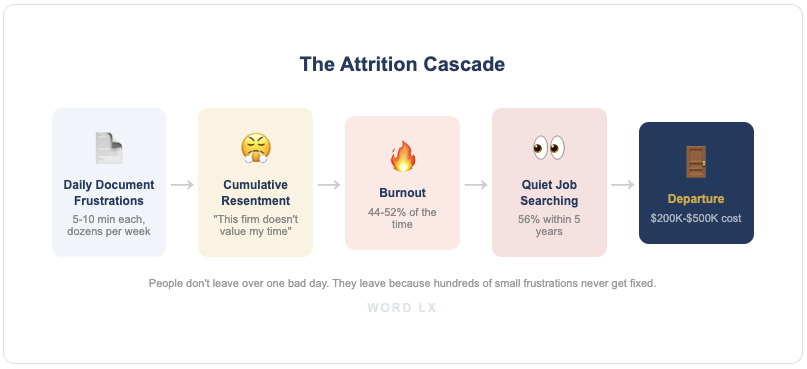
The burnout numbers are alarming. Bloomberg Law’s Workload and Hours Survey found that lawyers reported feeling burned out 44% to 52% of the time. The LawCare Life in the Law 2025 report found that 60% of lawyers reported poor mental wellbeing, with those aged 26 to 35 scoring the worst.
Nearly 78% of respondents in that same study said they regularly work beyond their contracted hours. More than half said they could see themselves leaving their current workplace within five years.
When you ask firms how they’re addressing retention, the answers are consistent: better pay, remote work options, mentorship programs, mental health resources. All valuable. All important.
But none of them address what’s happening inside the workday itself.
Lawyers aren’t just burning out from long hours. They’re burning out from how those hours are spent. And a surprising amount of that daily frustration comes from something most retention strategies never touch: document workflows.
The Document Workflow Connection Nobody Talks About in Law Firm Attorney Retention

Every lawyer knows the feeling. You open Microsoft Word to draft a letter, and you spend the first ten minutes hunting for the right template. You find one, but the letterhead is outdated. You fix the letterhead, paste in a clause from another document, and the formatting breaks. The numbering resets. The font changes. You spend another fifteen minutes getting the document to look right.
None of that was legal work. None of it was billable. And none of it needed to happen.
These moments are small individually. But they accumulate across every document, every day, every week. Five minutes fixing numbering here. Ten minutes reformatting a brief there. Fifteen minutes searching for the approved version of a standard clause. Twenty minutes rebuilding a template that no one maintains.
Research shows that these hidden costs quietly add up across a firm. A single attorney can lose more than 120 billable hours per year to avoidable document tasks. Across a team, that number climbs into the thousands.
But the real damage to law firm attorney retention goes beyond lost revenue. Every one of those moments chips away at an attorney’s sense that their work matters. Every hour spent fixing a document someone else broke is an hour that reinforces a simple message: this firm doesn’t value your time.
That message is what drives people to start looking elsewhere.
Why Tedious Work Hits Harder Than Long Hours
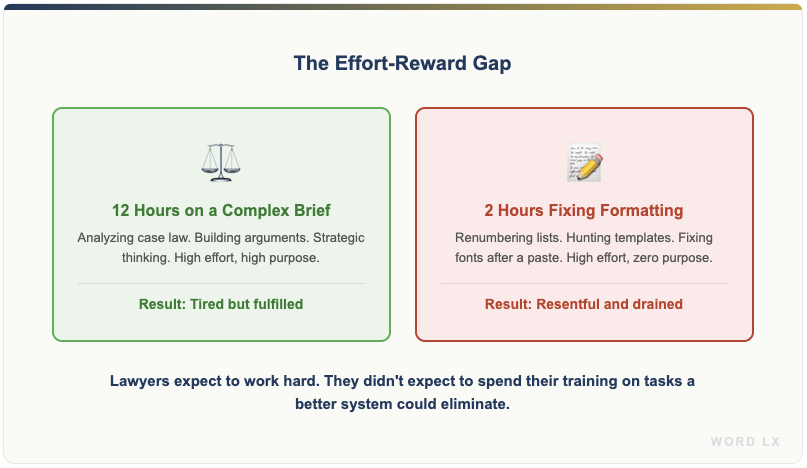
There’s a reason document frustrations contribute to burnout in ways that even long hours don’t always match. Attorneys expect to work hard. They signed up for that. What they didn’t sign up for is spending meaningful portions of their day on mechanical tasks that feel beneath their training.
A lawyer who spends twelve hours preparing a complex brief for an important case might be exhausted, but the work itself is engaging and purposeful. That same lawyer who spends two of those twelve hours fixing formatting issues, rebuilding numbered lists, and hunting for templates feels something different: resentment.
Psychologists who study workplace satisfaction call this perceived effort-reward imbalance. When the effort required doesn’t match the perceived value of the task, dissatisfaction increases sharply. Document formatting is the ultimate effort-reward imbalance for a trained attorney.
Ask any lawyer about their biggest Microsoft Word frustration, and you’ll hear about numbering, styles, and formatting that breaks without explanation. These frustrations are so common that lawyers joke about them. But underneath the humor is real daily friction that erodes job satisfaction one document at a time.
Firms that want to improve law firm attorney retention need to recognize that these small frustrations matter more than they appear. People don’t leave over one bad day. They leave because hundreds of small frustrations accumulate into a feeling that things will never get better.
How Fixing Document Workflows Improves Law Firm Attorney Retention
The good news is that document workflow problems are some of the most fixable retention risks a firm faces. Unlike compensation (which always has a ceiling) or culture (which takes years to shift), document systems can be improved quickly and the results show up immediately in every attorney’s daily experience.
Standardize Templates Firm-Wide
A well-maintained template library is the single highest-impact change most firms can make to improve law firm attorney retention at the workflow level. When every document starts from a professionally built, properly formatted template, attorneys skip the formatting phase entirely.
Templates should include pre-set styles, correct numbering schemes, proper margins, and branded elements so that the document is production-ready before a single word of substance is typed. The key is making templates accessible from within Microsoft Word, so lawyers don’t have to navigate shared drives or remember file names.
Build a Centralized Clause Library
Clause hunting is one of the most common and least visible time drains in legal practice. Attorneys spend significant time every week tracking down the most current version of standard paragraphs, disclaimers, and approved language.
A centralized clause library lets attorneys insert pre-approved content directly into any document with a few clicks, eliminating the time spent emailing colleagues, searching old files, or guessing whether a version is current.
Automate Repetitive Document Elements
Signature blocks, date fields, client information, matter numbers, letterheads, and watermarks all follow predictable patterns. Automating these elements so they populate dynamically eliminates minutes of manual entry on every document.
Those minutes add up to meaningful time savings across a year, and more importantly, they remove one more source of daily tedium from every attorney’s workday.
Lock Down Formatting at the Template Level
One of the most persistent sources of document frustration is formatting that breaks after a document has been edited by multiple people. Styles get overridden. Numbering resets. Fonts change. These issues are almost always fixable at the template level.
Protected styles, locked numbering schemes, and restricted font options keep documents consistent without requiring lawyers to think about formatting at all. When formatting simply works every time, an entire category of daily frustration disappears.
Centralize Template Administration
Template management breaks down when updates depend on a single person emailing new files or posting them to a shared drive. A centralized administration system allows template managers to push updates to all users simultaneously.
This is especially important for multi-office firms where inconsistency between locations creates both efficiency and morale problems.
Getting Started: A Practical First Step for Law Firm Attorney Retention
You don’t need to rebuild your entire document infrastructure to make progress on law firm attorney retention.
Start by running an audit of your current document workflows. Identify the five to ten documents your firm produces most frequently and ask your attorneys a simple question: what frustrates you most about creating these documents?
The answers will likely cluster around the same themes: outdated templates, broken formatting, missing clauses, inconsistent styles, and too many manual steps.
Improving just those high-volume documents with better templates, automated fields, and accessible clause libraries can produce immediate, noticeable results. Attorneys will feel the difference on the first day.
From there, expanding to additional document types becomes straightforward. Tools that work inside Microsoft Word make adoption easier because attorneys don’t need to learn a new system. They just need their existing system to stop wasting their time.
The firms that see the biggest improvements in law firm attorney retention are the ones that treat daily workflow experience as a retention strategy, not an IT project. Every small frustration you remove is a small reason to stay that you’ve added.
Frequently Asked Questions
Lawyers leave law firms for a combination of reasons including burnout, lack of growth opportunities, inadequate compensation, poor firm culture, and daily workflow frustrations. While compensation and flexibility are frequently cited, many attorneys point to the cumulative effect of small daily frustrations like repetitive document tasks, broken formatting, and outdated systems. Bloomberg Law found that lawyers feel burned out nearly half the time, and more than half of respondents in recent surveys said they could see themselves leaving their current firm within five years.
The ABA Journal estimates that replacing a single attorney costs between $200,000 and $500,000 when accounting for recruiting, onboarding, lost productivity, and disrupted client relationships. For larger firms, the NALP Foundation has estimated total annual turnover costs in the tens of millions. A firm with 800 lawyers at a 23% attrition rate and $350,000 per replacement faces roughly $64 million in annual turnover costs. Even small and mid-size firms feel the impact significantly, as every departure creates a ripple effect across the team.
The most sustainable approach combines systemic changes with individual support. Systemic changes include reducing the volume of tedious non-billable work through document automation, standardizing templates, and building clause libraries. Individual support includes mental health resources, mentorship, flexible work arrangements, and realistic workload expectations. The key insight is that reducing burnout requires changing the nature of the work, not just providing tools to cope with it. Eliminating repetitive document tasks alone can save each attorney 30 minutes or more per day, directly reducing one of the most common sources of daily frustration.
Associate attrition is driven by a combination of long hours, high-pressure environments, lack of meaningful work, limited mentorship, compensation that doesn’t match lifestyle costs, and cumulative workflow frustrations. The NALP Foundation found that 82% of associates who left in 2023 did so within five years of hiring. Younger attorneys aged 26 to 35 score highest for burnout and lowest for mental wellbeing. Many associates leave for other firms rather than leaving the profession, indicating that the work itself is appealing but the daily experience at their current firm is not.
Document automation eliminates the repetitive, low-value tasks that contribute to daily frustration and burnout. When templates are standardized, clauses are centralized, and formatting is locked at the template level, attorneys spend less time on mechanical work and more time on substantive legal analysis. This shift directly improves job satisfaction. Firms that implement structured document automation report that tasks like letter generation drop from 15 to 20 minutes to under 5 minutes. Across a year, those savings translate to more than 120 recovered hours per attorney, which is time that can go to billable work, professional development, or simply going home earlier.
Associate attrition rates vary by firm size, practice area, and market, but recent data shows rates between 16% and 27%. The Thomson Reuters State of the Legal Market report documented attrition rates as high as 23% in 2021, with the rate stabilizing slightly in subsequent years but remaining well above pre-pandemic levels. The NALP Foundation reported that departures are happening earlier in tenure than ever before, with the vast majority of exits occurring within the first five years. For firms focused on law firm attorney retention, these numbers underscore the importance of making the first several years of the employment experience as friction-free as possible.
Conclusion
Law firm attorney retention is not a single-solution problem. Compensation matters. Culture matters. Flexibility matters. But so does the daily experience of doing the work itself.
When your attorneys spend meaningful portions of every day on document tasks that feel repetitive, frustrating, and avoidable, those moments accumulate into something bigger: a quiet decision that this firm doesn’t respect their time.
Fixing document workflows won’t solve every retention challenge. But ignoring them guarantees you’ll keep losing people for reasons you never thought to ask about. The firms that treat document efficiency as a retention strategy, not just a productivity tool, are the ones that keep their best people longer.
Ready to remove one of the biggest hidden sources of attorney frustration?
Word LX helps law firms eliminate repetitive document work by providing smart templates, clause libraries, and formatting controls that work directly inside Microsoft Word. Book a demo to see how your firm can give attorneys their time back.