
Ask a lawyer how they produce a new engagement letter and the honest answer is usually the same. They open the last one, save it under a new name, and start editing. Change the client. Change the date. Hunt for the three clauses that were specific to the old matter. Hope they caught all of them.
That process works, right up until it does not. The wrong party name survives two rounds of edits. A clause from the previous deal stays in by accident. The numbering breaks. And every lawyer rebuilds the same document from scratch every time, because the knowledge of how to build it correctly lives in the last file rather than in a system.
Document assembly is the alternative, and it is one of the fastest-growing categories in legal technology. This piece explains what document assembly actually is, how it works, how it differs from templates and from AI drafting, and why more firms are adopting it now than at any point before.
Table of Contents
- What Is Document Assembly?
- How Document Assembly Works
- Document Assembly vs Templates vs AI Drafting
- Why Law Firms Are Adopting It Now
- What to Look For in a Document Assembly Solution
- FAQ
What Is Document Assembly?
Document assembly is the process of building a finished legal document automatically from a set of pre-approved components and a small amount of matter-specific input. Instead of editing last time’s file into this time’s deal, the lawyer answers a short set of questions, and the system assembles a correct, consistently formatted draft from a library of approved clauses and templates.
The core idea is simple. A large share of what a firm produces follows repeatable patterns. Engagement letters, retainer agreements, pleading shells, standard corporate resolutions, NDAs, and closing documents are not written from a blank page each time. They are variations on known structures. Document assembly captures those structures once, in a controlled template, then generates each new instance from data rather than from the previous document.
The result is a draft that starts correct. The party names are right because they were entered once and flow everywhere. The clauses are the approved versions because they came from the firm’s library. The numbering and formatting hold because they were defined in the template. The lawyer spends their time on the parts of the document that actually require judgment, rather than on the mechanical reconstruction of the parts that do not.
How Document Assembly Works
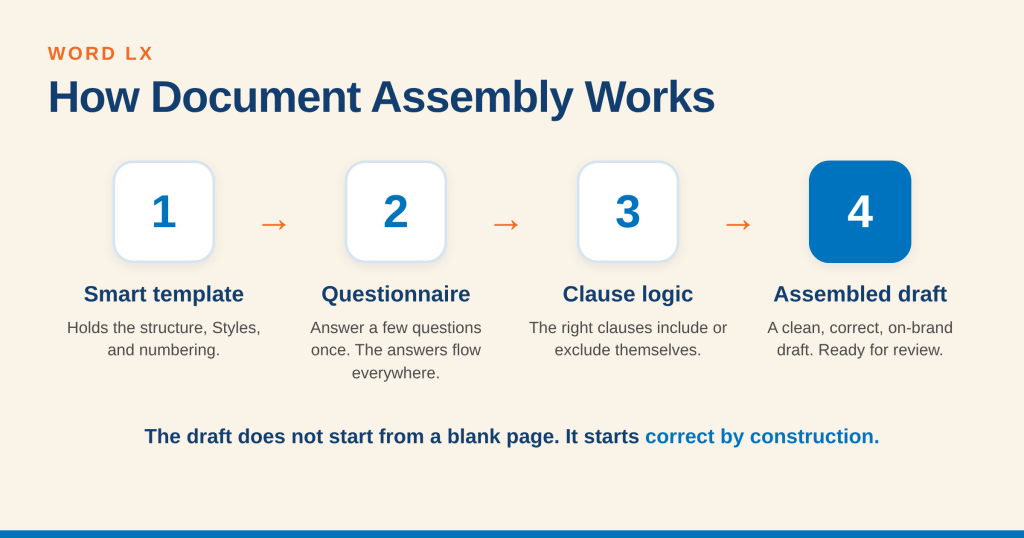
Under the surface, document assembly runs on four connected pieces.
1. The smart template
A master document with the fixed structure of the document type, plus placeholders for everything that changes. The template holds the Styles, numbering rules, and layout, so every output looks the same and formats the same. This is the foundation, and it is why Styles and consistent structure matter so much to firms that automate well.
2. The intake questionnaire
A short set of questions the lawyer or assistant answers to start a new document. Client name, matter type, jurisdiction, fee arrangement, and any options that change the content. Entered once, these answers populate every place in the document where they belong.
3. The clause logic
The rules that decide which clauses appear. If the matter is in one province, one governing-law clause is included. If the client is a corporation rather than an individual, the signature block adjusts. This conditional logic is where document assembly earns its value, because it removes the “did I remember to swap that clause” risk entirely.
4. The assembled draft
The system produces a clean, correctly numbered, on-brand draft, ready for the lawyer to review and refine. The starting point is a document that already reflects the firm’s approved language and structure, rather than a blank page or a lightly edited copy of last matter’s file.
Good document assembly lives where lawyers already work. Platforms such as Word LX run this entire process inside Microsoft Word as a ribbon-level add-in, so the firm does not have to move its document work into a separate application to get the benefit.
Document Assembly vs Templates vs AI Drafting
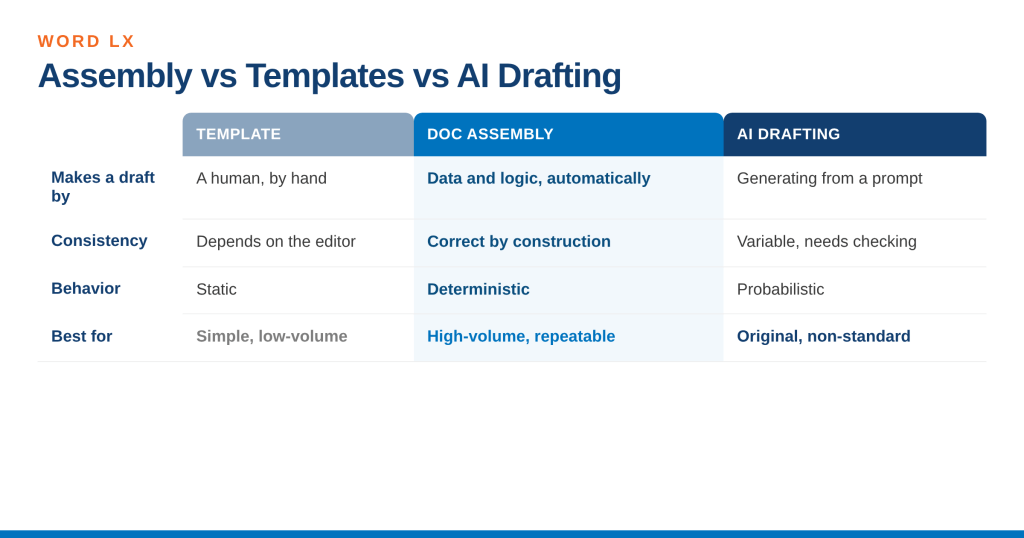
These three get conflated constantly, and the confusion leads firms to buy the wrong thing. Here is the distinction.
A plain template is a starting file. It gives you consistent formatting and boilerplate, but a human still has to fill it in, swap the variable clauses by hand, and catch every place the client name appears. It is better than a blank page and worse than assembly, because the accuracy still depends entirely on the person editing it.
Document assembly adds logic and data on top of the template. It fills in the variables automatically, includes or excludes clauses based on the answers to the questionnaire, and produces a draft that is correct by construction. It is built for the high-volume, repeatable documents that make up most of a firm’s output.
AI drafting generates language from a prompt. It is powerful for first drafts of non-standard content, for summarizing, and for research. It is also probabilistic, which means it can produce fluent text that is subtly wrong, and it does not guarantee that the output matches the firm’s approved language. We covered this distinction in depth in AI Drafting vs Document Automation: What Law Firms Actually Need.
The practical read: for the 60 to 80 percent of a firm’s document volume that follows repeatable patterns, document assembly is the right engine, because it is deterministic and it enforces the firm’s standards. AI is a strong complement for the remaining work that genuinely needs original drafting. The two are not competitors. They handle different parts of the same workload.
Why Law Firms Are Adopting It Now
Document assembly is not new. What changed is the pressure around it. Four forces are pushing adoption in 2026.
Volume and margin pressure. Clients push back on hours spent on work that looks mechanical. Time a lawyer spends rebuilding a standard agreement is time that is increasingly hard to bill. Assembly moves that time from the lawyer to the system.
Consistency and risk. Every hand-edited document is a chance for the wrong clause, the wrong party, or a broken cross-reference to slip through. Assembly removes whole categories of that risk by generating from approved components. The compounding cost of small errors is the same pattern we described in Why “Fixing It Later” Costs Law Firms More Than They Think.
The AI moment. As firms add AI to their stack, they are discovering that AI is only as good as the source material it works from. A firm with a clean, assembled document layer gets far more from AI than a firm whose documents are a pile of inconsistent past files. Getting the document foundation right is now a prerequisite for the AI investment to pay off. This is part of the broader shift toward workflow integration across the legal stack.
Talent and turnover. When a senior associate leaves, the knowledge of how to build the firm’s documents correctly should not leave with them. Assembly puts that knowledge in the system, so a new hire produces correct documents on day one instead of month six.
What to Look For in a Document Assembly Solution
Not every tool labeled “automation” solves the same problem. When a firm evaluates document assembly, these are the criteria that separate a real fit from a shelved purchase.
It fits the firm’s change-management reality. Adoption support and training matter as much as features. A tool nobody uses saves nobody time.
It works inside Microsoft Word. If lawyers have to leave Word to draft, adoption drops. The best assembly lives where the work already happens.
It manages clauses centrally. A single, governed clause library rather than clauses scattered across personal files.
It handles numbering and Styles. Assembly that does not control formatting just moves the formatting problem downstream.
It supports conditional logic. Real include and exclude rules, not just find and replace on a few fields.
Download the Document Assembly Buyer’s Checklist
A one-page evaluation tool for firms weighing document assembly. The questions to ask each vendor, a readiness check for your own firm, and the red flags that predict a shelved purchase. Free PDF.
DOWNLOAD CHECKLISTOne more piece worth naming. Document assembly and clean numbering reinforce each other. When clauses come from a managed library instead of a copy-paste from an old matter, the most common source of numbering chaos disappears at the source. We wrote about that failure mode in Legal Document Numbering in Word: Why It Breaks and How to Fix It.
Frequently Asked Questions
Document assembly is the automated creation of legal documents from pre-approved components and matter-specific input. Instead of editing a previous file, a lawyer answers a short questionnaire, and the system builds a correctly formatted draft from a library of approved clauses and templates. It is used most for high-volume, repeatable documents like engagement letters, NDAs, and standard agreements.
A template is a starting file that a person still fills in by hand, so accuracy depends on the editor. Document assembly adds data and logic on top of the template. It populates variables automatically and includes or excludes clauses based on the matter, producing a draft that is correct by construction rather than by careful editing.
No. Document assembly is deterministic. It builds documents from the firm’s approved clauses using fixed rules, so the output is predictable and on-standard. AI drafting generates language probabilistically from a prompt, which is powerful for original content but does not guarantee the output matches approved language. Most firms use assembly for repeatable documents and AI for non-standard drafting.
Industry estimates put 60-80% of a typical firm’s document output in the repeatable-pattern category, which is the work document assembly is built to handle. The remaining share involves original drafting that still benefits from a lawyer’s judgment, sometimes assisted by AI.
The strongest solutions do. Platforms such as Word LX run document assembly inside Microsoft Word as a ribbon-level add-in, so lawyers draft where they already work. Assembly that forces lawyers into a separate application tends to see lower adoption, which undercuts the time savings.